
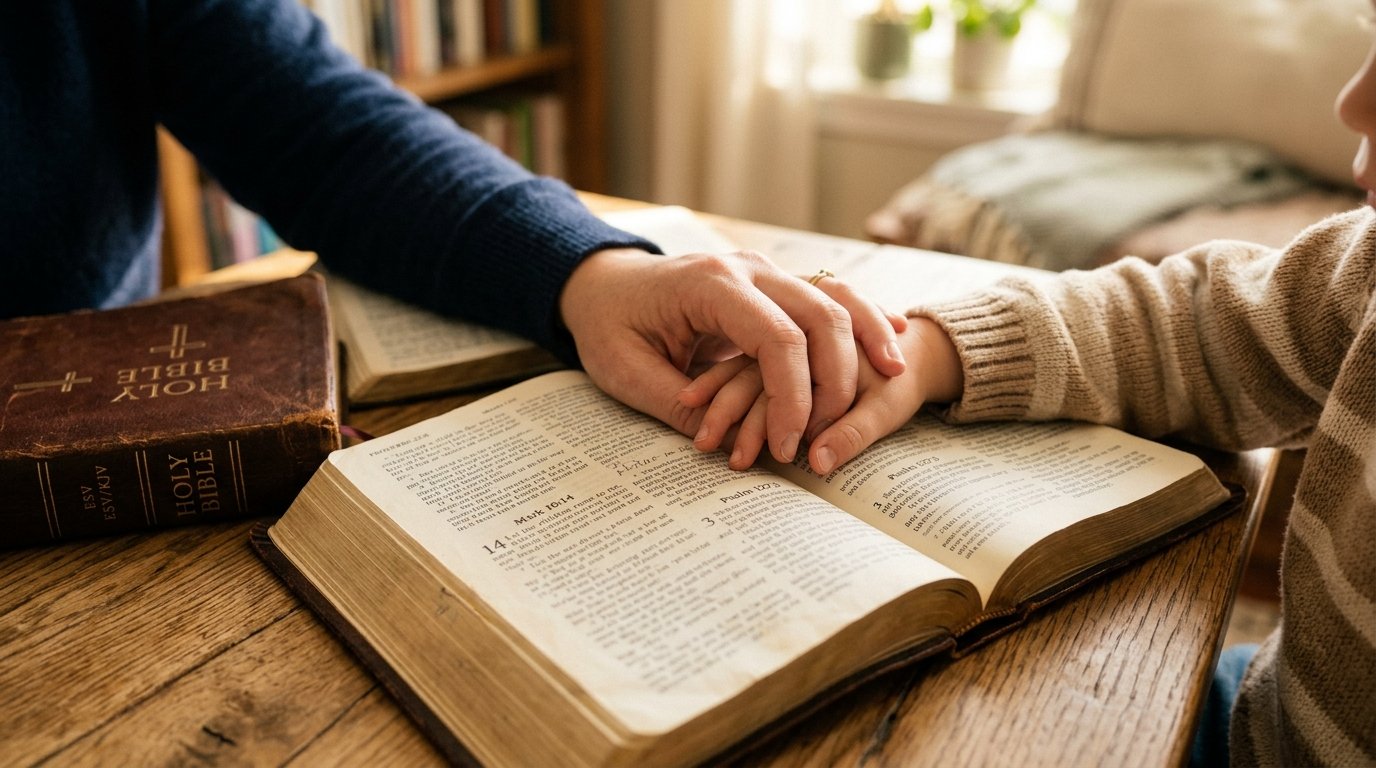
If you are looking for bible verses about children — whether to pray over your kids, teach in Sunday school, or understand what Scripture actually says about childhood — this guide organizes the most important passages by theme, with the historical context and meaning behind each one.
Quick Answer: The most well-known bible verse about children is Psalm 127:3 — “Children are a heritage from the Lord, offspring a reward from Him.” But Scripture says far more than this single verse. From Genesis to the Gospels, the Bible presents children as blessings, image-bearers of God, and central participants in His kingdom — not background characters in an adult story.
Key Bible Verses About Children at a Glance
| Theme | Verse | Key Scripture |
|---|---|---|
| Children as a blessing | Psalm 127:3 | “Children are a heritage from the Lord, offspring a reward from Him.” |
| Teaching children | Deuteronomy 6:6–7 | “Impress them on your children. Talk about them when you sit at home and when you walk along the road.” |
| Jesus welcomes children | Mark 10:14 | “Let the little children come to me, and do not hinder them, for the kingdom of God belongs to such as these.” |
| A child’s identity | Psalm 139:13–14 | “For you created my inmost being; you knit me together in my mother’s womb.” |
| Protection | Matthew 18:10 | “See that you do not despise one of these little ones. For I tell you that their angels in heaven always see the face of my Father.” |
| Training | Proverbs 22:6 | “Start children off on the way they should go, and even when they are old they will not turn from it.” |
A note from The Verse Path team: We organized this guide by theme rather than listing random verses because parents, teachers, and students need different scriptures for different moments. A parent praying over a newborn needs different words than a teacher preparing a lesson on obedience. Each section below serves a specific purpose. If you are new to studying Scripture in depth, our guide on how to read the Bible explains the methods and reading strategies that will help you get the most out of every verse below.
Bible Verses About Children as a Blessing from God
The Old Testament consistently presents children not as burdens or accidents, but as deliberate gifts from God — evidence of His favor and faithfulness to a family. These bible verses about children as blessings form one of the strongest themes in all of Scripture.
Psalm 127:3–5 (NIV) “Children are a heritage from the Lord, offspring a reward from him. Like arrows in the hands of a warrior are children born in one’s youth. Blessed is the man whose quiver is full of them.”
The word “heritage” in Hebrew (naḥălâ) is the same word used for the Promised Land that God gave to Israel. The psalmist is saying that children carry the same weight of divine promise as the land itself. They are not a side blessing — they are a covenant gift.
Genesis 33:5 (NIV) “Then Esau looked up and saw the women and children. ‘Who are these with you?’ he asked. Jacob answered, ‘They are the children God has graciously given your servant.'”
After twenty years of separation and hostility, Jacob presents his children to his estranged brother Esau. Notice Jacob’s language: he does not say “my children” possessively. He says “the children God has graciously given.” Even in a moment of intense personal anxiety, Jacob recognizes that his children ultimately belong to God.
Psalm 113:9 (NIV) “He settles the childless woman in her home as a happy mother of children. Praise the Lord.”
This psalm was sung during Passover — the most important annual celebration in Israel. Placing this verse in the Passover liturgy meant that every Jewish family, every year, publicly affirmed that God is the one who gives children. It was not a private sentiment. It was national theology.
3 John 1:4 (NIV) “I have no greater joy than to hear that my children are walking in the truth.”
The apostle John is writing about his spiritual children (believers he mentored), but the principle resonates universally: the deepest joy a parent or mentor experiences is seeing the next generation live with integrity and faith.
Bible Verses About Teaching and Raising Children
Scripture does not leave parenting to instinct. It provides a specific framework for how children should be taught — and that framework centers on daily, integrated, relational instruction, not isolated religious events. These bible verses about children and education reveal a parenting model that is remarkably practical.
Deuteronomy 6:6–7 (NIV) “These commandments that I give you today are to be on your hearts. Impress them on your children. Talk about them when you sit at home and when you walk along the road, when you lie down and when you get up.”
This is the most important parenting passage in the entire Old Testament. Moses is speaking to Israel just before they enter the Promised Land. The instruction is radically practical: spiritual teaching should happen during normal life — at meals, during travel, at bedtime, in the morning. It is woven into the rhythm of everyday existence, not confined to a weekly synagogue visit.
Proverbs 22:6 (NIV) “Start children off on the way they should go, and even when they are old they will not turn from it.”
This is the most quoted — and most misunderstood — bible verse about children in the entire Book of Proverbs. It is a wisdom observation, not an unconditional guarantee. The Hebrew phrase “the way he should go” (al-pî darkô) literally means “according to his way” — suggesting that wise parenting adapts to the unique nature and temperament of each child, rather than applying a one-size-fits-all method. For more on how Proverbs function as wisdom literature rather than absolute promises, see our explanation of Proverbs 3:5-6 on leaning not on your own understanding.
Ephesians 6:4 (NIV) “Fathers, do not exasperate your children; instead, bring them up in the training and instruction of the Lord.”
Paul is writing to the church in Ephesus, a Roman city where fathers had absolute legal authority over their children (patria potestas) — including the right to abandon, sell, or physically punish them without limit. Paul’s command to “not exasperate” was revolutionary in that culture. He is telling fathers that authority without empathy produces resentment, not godliness.
Psalm 78:4 (NIV) “We will not hide them from their descendants; we will tell the next generation the praiseworthy deeds of the Lord, his power, and the wonders he has done.”
This psalm functions as a historical curriculum. The psalmist is commanding Israel to pass down the national story — the Exodus, the wilderness, the conquest — to every new generation. The logic is clear: a generation that does not know its story will repeat its ancestors’ failures.
What Jesus Said About Children
Jesus’ treatment of children was shocking in the ancient world. In first-century Jewish and Roman culture, children had virtually no social status. They were loved within families, but they carried no public honor, no legal standing, and no voice. Jesus deliberately reversed this hierarchy — making some of the most powerful bible verses about children ever recorded.
Mark 10:13–16 (NIV) “People were bringing little children to Jesus for him to place his hands on them, but the disciples rebuked them. When Jesus saw this, he was indignant. He said to them, ‘Let the little children come to me, and do not hinder them, for the kingdom of God belongs to such as these. Truly I tell you, anyone who will not receive the kingdom of God like a little child will never enter it.’ And he took the children in his arms, placed his hands on them and blessed them.”
The word “indignant” (aganakteō) is one of the strongest emotional reactions attributed to Jesus in the Gospels. He was not mildly annoyed — He was genuinely angry. The disciples were acting as cultural gatekeepers, assuming that children were not worthy of a rabbi’s time. Jesus did not just tolerate the children. He held them, blessed them, and made them the theological model for how adults should approach God.
Matthew 18:1–5 (NIV) “At that time the disciples came to Jesus and asked, ‘Who, then, is the greatest in the kingdom of heaven?’ He called a little child to him, and placed the child among them. And he said: ‘Truly I tell you, unless you change and become like little children, you will never enter the kingdom of heaven. Therefore, whoever takes the lowly position of this child is the greatest in the kingdom of heaven. And whoever welcomes one such child in my name welcomes me.'”
The disciples are arguing about rank and power. Jesus responds by placing a child — the lowest-status person in the room — at the center and declaring that greatness in God’s kingdom is measured by humility, not authority. This was not a sentimental statement about childhood innocence. It was a direct challenge to the disciples’ ambition.
Matthew 18:10 (NIV) “See that you do not despise one of these little ones. For I tell you that their angels in heaven always see the face of my Father in heaven.”
Jesus issues a warning: harming or dismissing children carries spiritual consequences. The phrase “their angels always see the face of my Father” implies that children have a direct, unobstructed connection to God’s presence — a status that even the most powerful adults cannot claim by their own merit.
Matthew 19:14 (NIV) “Jesus said, ‘Let the little children come to me, and do not hinder them, for the kingdom of heaven belongs to such as these.'”
This verse appears in three of the four Gospels (Matthew, Mark, and Luke), which indicates that the early church considered it one of the most important bible verses about children in Jesus’ entire ministry. The repetition across multiple authors signals theological weight, not redundancy.
Bible Verses About Children’s Identity and Worth
These scriptures speak directly to how God sees every child — not as a project to be completed, but as a person already known, valued, and purposefully designed. Among all the bible verses about children, these may be the most intimate.
Psalm 139:13–16 (NIV) “For you created my inmost being; you knit me together in my mother’s womb. I praise you because I am fearfully and wonderfully made; your works are wonderful, I know that full well. My frame was not hidden from you when I was made in the secret place, when I was woven together in the depths of the earth. Your eyes saw my unformed body; all the days ordained for me were written in your book before one of them came to be.”
David uses the language of a skilled craftsman — knitting, weaving — to describe God’s involvement in forming a child. The Hebrew word rāqam (“woven together”) was used for embroidery, the most intricate and deliberate form of textile art in the ancient Near East. David is saying that every child is not mass-produced. Every child is handcrafted.
Jeremiah 1:5 (NIV) “Before I formed you in the womb I knew you, before you were born I set you apart; I appointed you as a prophet to the nations.”
God is speaking to the prophet Jeremiah, telling him that his identity and calling existed before his physical existence. While this verse applies specifically to Jeremiah’s prophetic mission, the underlying principle — that God knows and purposes children before birth — resonates throughout Scripture.
Isaiah 49:15 (NIV) “Can a mother forget the baby at her breast and have no compassion on the child she has borne? Though she may forget, I will not forget you!”
God uses the strongest human bond — a nursing mother and her infant — as a comparison for His own faithfulness. And then He says His commitment is even stronger than that bond. This is one of the most emotionally powerful bible verses about children in the entire Old Testament.
Bible Verses About Children for Parents Who Are Struggling
Parenting is not always joyful. Scripture does not pretend otherwise. These bible verses about children speak to parents in seasons of exhaustion, fear, grief, or uncertainty.
Isaiah 54:13 (NIV) “All your children will be taught by the Lord, and great will be their peace.”
God is speaking to Israel after a season of devastation. The promise is not that parenting will be easy, but that God Himself will be the ultimate teacher of your children. For a parent who feels inadequate, this is profoundly reassuring: the responsibility does not rest on you alone.
Proverbs 31:28 (NIV) “Her children arise and call her blessed; her husband also, and he praises her.”
This verse comes at the end of the Proverbs 31 poem, which describes a woman of extraordinary strength and competence. But notice what validates her life in the end: not her accomplishments, but the words of her children. The fruit of faithful parenting is often invisible for years before it becomes visible.
Lamentations 2:19 (NIV) “Arise, cry out in the night, as the watches of the night begin; pour out your heart like water in the presence of the Lord. Lift up your hands to him for the lives of your children.”
This is the Bible’s most raw parenting prayer. Jeremiah is writing during the destruction of Jerusalem, when families are starving and children are dying. He does not offer a theological explanation. He simply says: pour out your heart to God for your children. Sometimes prayer is not structured. Sometimes it is just a cry. For a deeper study on how to align your prayers with God’s purposes, see our guide on what to pray for the kingdom.
2 Timothy 1:5 (NIV) “I am reminded of your sincere faith, which first lived in your grandmother Lois and in your mother Eunice and, I am persuaded, now lives in you also.”
Paul is writing to his young protégé Timothy, and he traces Timothy’s faith back through three generations — grandmother, mother, son. This verse reminds parents and grandparents that faithfulness is often cumulative. You may not see the full impact of your spiritual investment in your children’s lifetime. But it compounds.
Frequently Asked Questions
What does the Bible say about children?
The Bible consistently presents children as blessings from God (Psalm 127:3), image-bearers with inherent dignity (Psalm 139:13–14), and models of the humility required to enter God’s kingdom (Matthew 18:3–4). Both the Old and New Testaments command parents to teach children God’s ways through daily, relational instruction (Deuteronomy 6:6–7) and to raise them with patience rather than harshness (Ephesians 6:4).
What is the most popular bible verse about children?
The most widely quoted bible verse about children is Psalm 127:3 — “Children are a heritage from the Lord, offspring a reward from Him.” It appears frequently in baby dedications, birth announcements, and church celebrations. Mark 10:14 — Jesus saying “Let the little children come to me” — is the most quoted verse about children in the New Testament.
What Bible verse should I pray over my child?
Psalm 139:13–14 is one of the most powerful scriptures to pray over a child because it affirms their identity as intentionally created by God. Isaiah 54:13 (“All your children will be taught by the Lord, and great will be their peace”) is ideal for parents who want to entrust their child’s spiritual growth to God. Numbers 6:24–26 (the Aaronic Blessing: “The Lord bless you and keep you”) has been used as a blessing over children for over 3,000 years.
Are there bible verses about children and protection?
Yes. Matthew 18:10 is the strongest: Jesus warns that the “little ones” have angels who stand directly before God’s face — implying that harming or neglecting children carries serious spiritual consequences. Psalm 82:3 commands God’s people to “Defend the weak and the fatherless; uphold the cause of the poor and the oppressed” — a mandate that explicitly includes vulnerable children.
What did Jesus say about children?
Jesus made children central to His teaching on the kingdom of God. In Mark 10:13–16, He rebuked His own disciples for turning children away and declared that the kingdom of God belongs to those who are like children. In Matthew 18:1–5, He placed a child in the middle of a debate about greatness and said that humility — not power — defines kingdom status. Jesus’ treatment of children was countercultural in a society that gave them almost no public standing.
Summary
The bible verses about children collected in this guide reveal a consistent, powerful truth across both Testaments: God does not view children as incomplete adults waiting to matter. He views them as heritage, reward, and living examples of the trust and humility He desires from every human being.
Whether you are a parent praying over a newborn, a teacher preparing a lesson, or someone simply wanting to understand what Scripture says — these bible verses about children show that kids are not on the margins of God’s story. They are at the center of it.
Published by The Verse Path — Lighting your journey through God’s Word.