
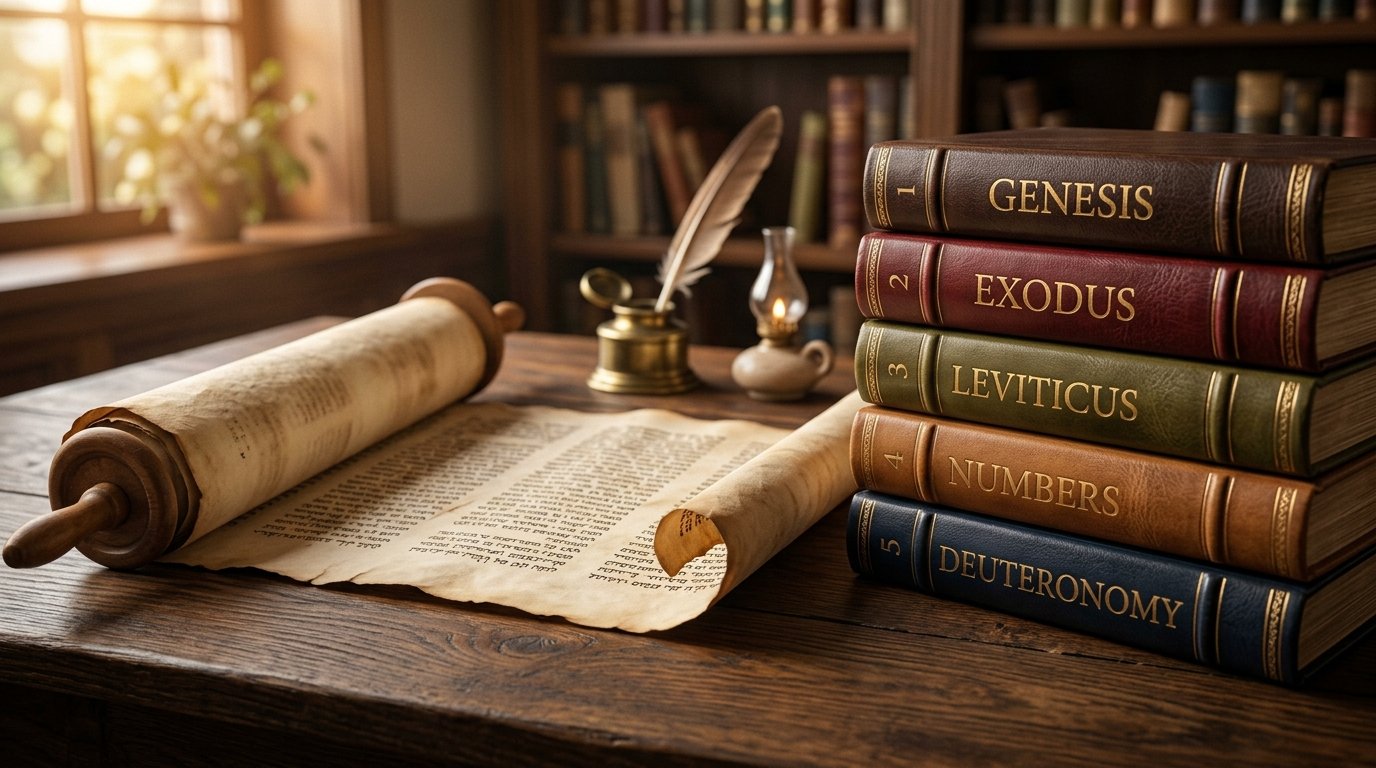
If you have ever wondered what the first 5 books of the Bible are, why they are grouped together, or how to actually read them without getting lost in Leviticus — this guide covers everything you need to know. These five books form the foundation of the entire Bible, and understanding them changes how you read every page that follows.
Quick Answer: The first 5 books of the Bible are Genesis, Exodus, Leviticus, Numbers, and Deuteronomy. Together they are called the Pentateuch (from the Greek pentateuchos, meaning “five scrolls”) or the Torah (Hebrew for “instruction” or “teaching”). Jewish and Christian tradition attributes their authorship primarily to Moses, and they cover everything from the creation of the world to Israel standing at the border of the Promised Land.
The First 5 Books of the Bible at a Glance
| Book | Meaning of Name | Key Event | Central Theme |
|---|---|---|---|
| Genesis | “Beginning” (Greek) | Creation, the Fall, Abraham’s call | God creates and chooses a people |
| Exodus | “Going out” (Greek) | The Exodus from Egypt, Mount Sinai | God delivers and makes a covenant |
| Leviticus | “Relating to Levites” (Latin) | Sacrificial laws, Day of Atonement | God teaches His people how to worship |
| Numbers | “In the wilderness” (Hebrew: Bemidbar) | 40 years of wandering | God disciplines and sustains |
| Deuteronomy | “Second law” (Greek) | Moses’ farewell speeches | God renews the covenant before Canaan |
A note from The Verse Path team: Most online guides about the Pentateuch give you five one-paragraph summaries and stop. We wrote this guide to show you how these five books connect into a single, continuous narrative — and why they matter for everything that comes after them in Scripture. If you are new to reading the Bible in depth, our companion guide on how to read the Bible will give you the reading strategies and methods to get the most out of these books.
What Are the First 5 Books of the Bible?
The first 5 books of the Bible — Genesis, Exodus, Leviticus, Numbers, and Deuteronomy — form a single literary unit that tells one continuous story: how God created the world, chose a family, rescued that family from slavery, gave them His law, and brought them to the edge of a new homeland.
This collection goes by three names depending on the tradition:
Torah — The Hebrew word meaning “instruction” or “teaching.” This is the term used in Jewish tradition. The Torah is not merely a legal code. It is narrative, poetry, law, and theology woven together into a single tapestry. When Jesus refers to “the Law” in the Gospels, He is almost always referring to the Torah.
Pentateuch — From the Greek pentateuchos, meaning “five-volume work.” This is the term most commonly used in academic and Christian theological discussions.
Books of Moses — The traditional designation based on the belief that Moses is the primary author. You will encounter this phrase throughout church history, commentaries, and older Bible translations.
Understanding that these five books are one unified work — not five independent books that happen to sit next to each other — is the single most important insight for reading them well. The story that begins in Genesis 1 does not reach its resolution until Deuteronomy 34. Every law in Leviticus, every census in Numbers, and every speech in Deuteronomy exists within that narrative arc.
A Closer Look at Each of the First 5 Books of the Bible
Genesis — The Book of Beginnings
Genesis covers more narrative ground than any other book in the Bible: from the creation of the universe to the death of Joseph in Egypt — a span of thousands of years compressed into 50 chapters.
The book divides into two major sections:
Chapters 1–11: Primeval History. Creation, the Garden of Eden, the Fall, Cain and Abel, Noah’s flood, the Tower of Babel. These chapters establish the fundamental problem of the entire Bible: humanity was created for relationship with God but consistently chooses rebellion. Each story shows the problem escalating — from individual sin (Adam and Eve) to family violence (Cain) to global corruption (the flood) to collective arrogance (Babel).
Chapters 12–50: Patriarchal Narratives. God’s response to the problem of chapters 1–11 is not destruction but election. He chooses one man — Abraham — and promises to make his descendants into a great nation that will bless all the families of the earth (Genesis 12:3). The rest of Genesis follows four generations: Abraham, Isaac, Jacob, and Joseph. By the final chapter, Jacob’s family of 70 people has settled in Egypt — setting the stage for Exodus.
Why it matters: Every major theme in the Bible — creation, sin, judgment, grace, covenant, promise — is introduced in Genesis. You cannot understand Paul’s letter to the Romans, the Gospel of John, or the Book of Revelation without Genesis.
Exodus — Liberation and Covenant
Exodus opens approximately 400 years after Genesis ends. Abraham’s family has grown into a large population, and Egypt’s Pharaoh has enslaved them. The book tells two connected stories:
Chapters 1–18: Deliverance. God calls Moses from a burning bush, sends ten plagues on Egypt, and liberates Israel through the Red Sea. This is the defining event of the Old Testament — the moment God proves that He keeps His promises to Abraham, even when centuries have passed. The Passover, established in Exodus 12, becomes the most important annual celebration in Jewish life and the direct backdrop for Jesus’ Last Supper.
Chapters 19–40: Covenant and Tabernacle. At Mount Sinai, God gives Israel the Ten Commandments and an extensive legal code governing worship, justice, and community life. He then instructs Moses to build the Tabernacle — a portable tent-sanctuary where God’s presence will physically dwell among His people. The Tabernacle is described in extraordinary detail because it communicates a radical theological claim: the Creator of the universe wants to live in the middle of a refugee camp.
Leviticus — Holiness and Worship
Leviticus is the book where most Bible readers give up. It contains detailed instructions for animal sacrifices, skin disease protocols, dietary laws, and priestly rituals that feel completely foreign to modern readers.
But Leviticus answers the most important question raised by Exodus: If God now lives among His people, how do sinful humans survive in the presence of a holy God?
The answer is the sacrificial system — a structured way for Israel to address sin, restore relationship, and approach God safely. The central event is the Day of Atonement (Yom Kippur, Leviticus 16), when the high priest enters the Most Holy Place once per year to make atonement for the entire nation. The New Testament book of Hebrews interprets Jesus’ crucifixion as the ultimate and final Day of Atonement — the sacrifice that makes all other sacrifices unnecessary.
The key phrase of Leviticus, repeated over 50 times, is: “Be holy, because I, the Lord your God, am holy” (Leviticus 19:2). Holiness in Leviticus is not abstract spirituality. It is practical distinction — living differently from the surrounding nations in diet, sexuality, economics, and worship.
Numbers — Wilderness and Wandering
Numbers covers the 40 years between Mount Sinai and the border of the Promised Land. The Hebrew title is Bemidbar — “In the wilderness” — which captures the book’s character far better than the English title.
The book alternates between two types of content:
Census records and organizational data — troop counts, tribal arrangements, march orders. These sections feel dry, but they serve a theological purpose: God is organizing a nation, not just saving individuals. Israel is being structured for life in a new land.
Rebellion narratives — The people complain about food. They refuse to enter the Promised Land after spies report fortified cities. Korah leads a revolt against Moses’ leadership. Even Moses himself disobeys God at the waters of Meribah (Numbers 20:10–12) and is told he will not enter the Promised Land.
Numbers is the Bible’s most honest portrait of what happens when a people who have been rescued by God still don’t trust Him. The 40-year wilderness period is not a punishment for one mistake — it is the consequence of a pattern of unbelief.
Deuteronomy — Moses’ Final Words
Deuteronomy is structured as a series of farewell speeches delivered by Moses on the plains of Moab, with the Promised Land visible across the Jordan River. Moses knows he will not cross over. These are his last words to the nation he has led for 40 years.
The book revisits and restates much of the law given in Exodus and Leviticus — hence the name Deuteronomion (“second law”) — but with a crucial difference in tone. Where Sinai was a mountaintop encounter with fire and thunder, Deuteronomy is a pastoral conversation. Moses is not just giving laws. He is pleading with the next generation to remember.
The most famous passage is the Shema (Deuteronomy 6:4–9): “Hear, O Israel: The Lord our God, the Lord is one. Love the Lord your God with all your heart and with all your soul and with all your strength.” When Jesus is asked to name the greatest commandment (Mark 12:29–30), He quotes this verse. It is the theological center of the entire Torah.
Deuteronomy ends with Moses’ death on Mount Nebo (chapter 34) — one of the most poignant scenes in all of Scripture. He sees the Promised Land from a distance but never enters it. The story remains unfinished, pointing forward to Joshua and ultimately to Christ.
Who Wrote the First 5 Books of the Bible?
Both Jewish and Christian tradition have long associated the first 5 books of the Bible with Moses. Jesus Himself refers to them as the writings of Moses (Mark 12:26, Luke 24:27, John 5:46), and the books themselves describe Moses writing down laws and events (Exodus 24:4, Deuteronomy 31:9).
At the same time, scholars have noted features within the text that suggest editorial work beyond Moses’ lifetime — most obviously the account of Moses’ own death in Deuteronomy 34, as well as phrases like “to this day” that imply significant time has passed.
The most responsible position, held by many conservative and evangelical scholars, is that Moses is the primary and substantial author of the Pentateuch, while later editors (possibly Joshua or scribes during the monarchy period) made minor additions, updates, and the final arrangement of the text. This view takes both the biblical claims and the textual evidence seriously without forcing a false choice between them.
Key Themes Running Through the First 5 Books of the Bible
Reading the first 5 books of the Bible as isolated stories misses the threads that tie them together. These five themes run from Genesis 1 through Deuteronomy 34:
Covenant — God makes binding promises to Noah (Genesis 9), Abraham (Genesis 15, 17), and Israel at Sinai (Exodus 19–24). Each covenant builds on the previous one. Understanding covenant is essential for understanding the entire Bible — including why the two halves are called the “Old Testament” and “New Testament” (testament = covenant).
Promise and Fulfillment — God promises Abraham land, descendants, and blessing (Genesis 12:1–3). The rest of the Pentateuch tracks the slow, incomplete, often-threatened fulfillment of those promises. By Deuteronomy, Israel has the descendants and the law but still has not entered the land. The tension is deliberate.
Holiness and Separation — From the dietary laws of Leviticus to the community regulations of Deuteronomy, the Torah consistently teaches Israel to live differently from surrounding nations. Holiness in the Pentateuch is not moral perfection — it is purposeful distinction.
God’s Presence — The narrative arc from Eden (God walking with humans) to the Tabernacle (God dwelling among Israel) to the wilderness (God guiding by cloud and fire) reveals a God who relentlessly pursues physical proximity with His people, despite their failures.
Human Failure and Divine Faithfulness — Every generation in the Pentateuch fails. Adam sins. The pre-flood world corrupts itself. Abraham lies. Israel builds a golden calf. Moses strikes the rock. And yet God does not abandon the project. This tension between human rebellion and divine commitment is the engine that drives the entire biblical narrative forward.
How to Read the First 5 Books of the Bible Effectively
Many readers attempt the Pentateuch and quit halfway through Leviticus. Here are three practical strategies that will help you read all five books with comprehension:
Read Genesis and Exodus first, then skip to Deuteronomy. Genesis and Exodus contain the narrative foundation. Deuteronomy restates the law in a more accessible, sermon-like format. Once you have this framework, go back and read Leviticus and Numbers — they will make far more sense because you already know the story they are embedded in.
Watch the Bible Project overview video for each book before reading it. These free 5–8 minute animated videos explain the literary structure and key themes of each book. They are the single best preparation tool for first-time readers of the Pentateuch.
Use a study resource for Leviticus. Leviticus is genuinely difficult without cultural context. A tool like Blue Letter Bible lets you look up the Hebrew meaning of sacrificial terms and cross-reference them with their New Testament fulfillment in Hebrews. This transforms Leviticus from a confusing ritual manual into a rich theological text about how God makes reconciliation possible.
Frequently Asked Questions
What are the first 5 books of the Bible called?
The first 5 books of the Bible are collectively called the Pentateuch (Greek for “five scrolls”), the Torah (Hebrew for “instruction”), or the Books of Moses. In Jewish worship, the Torah is the most sacred section of Scripture — the portion read aloud in synagogues on a weekly cycle that completes once per year.
Who wrote the first 5 books of the Bible?
Jewish and Christian tradition attributes the first 5 books of the Bible primarily to Moses. Jesus refers to them as Moses’ writings in multiple Gospel passages (Mark 12:26, John 5:46). Most conservative scholars hold that Moses is the substantial author, with minor editorial additions made by later scribes — including the account of his death in Deuteronomy 34.
What is the difference between the Torah and the Pentateuch?
There is no difference in content — both terms refer to Genesis, Exodus, Leviticus, Numbers, and Deuteronomy. Torah is the Hebrew term used in Jewish tradition, emphasizing the books’ role as divine instruction for life. Pentateuch is the Greek-origin term used in academic and Christian theological contexts, simply meaning “five-volume work.”
Why is Leviticus so hard to read?
Leviticus is difficult for modern readers because it describes a sacrificial worship system that no longer exists. The animal offerings, purity laws, and priestly rituals were designed for ancient Israel’s Tabernacle worship. However, the New Testament book of Hebrews explains that these rituals were shadows pointing to Christ’s ultimate sacrifice (Hebrews 10:1). Reading Leviticus with Hebrews open beside it reveals the theological purpose behind every regulation.
Are the first 5 books of the Bible historically accurate?
Archaeological discoveries — including ancient Near Eastern law codes (like the Code of Hammurabi), Egyptian records of Semitic slaves, and wilderness-era settlement patterns — are consistent with the cultural and historical world described in the Pentateuch. While debates continue among scholars about specific dates and details, the first 5 books of the Bible reflect authentic Bronze Age settings, legal traditions, and covenant structures that would be difficult to fabricate centuries later.
In what order should I read the first 5 books of the Bible?
For first-time readers, the most effective order is: Genesis → Exodus → Deuteronomy → Leviticus → Numbers. Genesis and Exodus give you the story. Deuteronomy gives you the theological summary. Then Leviticus and Numbers fill in the details that make far more sense once you understand the narrative arc.
Summary
The first 5 books of the Bible are not just the opening chapters of Scripture — they are the foundation that every later author assumes you already know. The prophets quote them. The psalmists sing about them. Jesus teaches from them. Paul argues from them. Revelation echoes them.
Genesis gives you the problem. Exodus gives you the rescue. Leviticus gives you the way back to God. Numbers gives you the cost of unbelief. Deuteronomy gives you the choice: life or death, blessing or curse, faithfulness or forgetfulness.
Start with Genesis. Read the story. And everything that follows in the Bible will begin to make sense.
Published by The Verse Path — Lighting your journey through God’s Word.